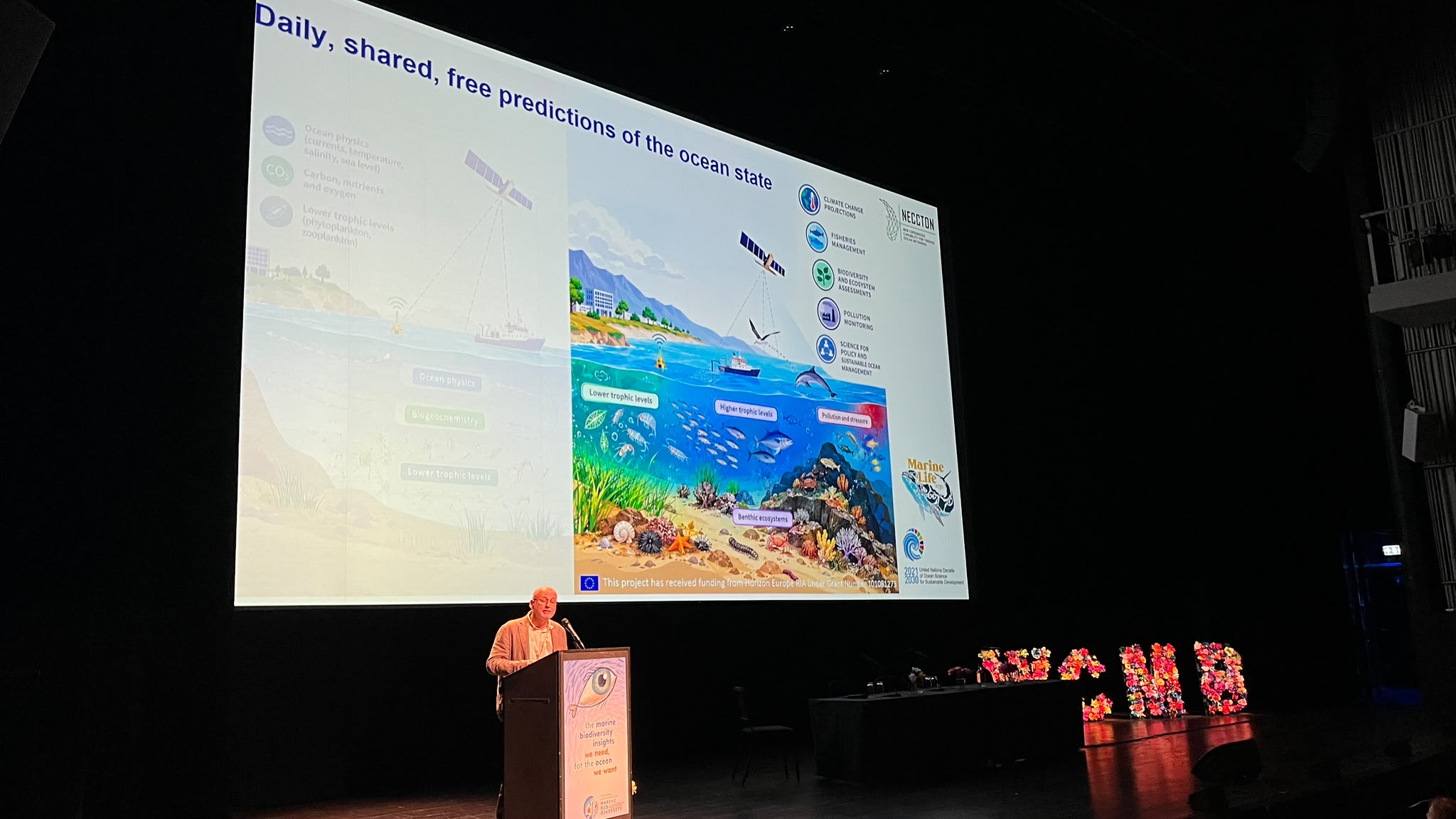
Taking place from 17–20 November 2026, the conference brought together the global marine biodiversity community to share research, approaches and ideas for understanding and protecting ocean ecosystems.
Bringing marine ecosystem modelling into operation
A major focus for NECCTON was a dedicated conference session on operational marine ecosystem modelling, chaired by the project.
The session, Bringing marine ecosystem modelling into operation to predict and protect ocean biodiversity, explored how developments in ecosystem modelling are improving our ability to understand, monitor and predict changes in marine biodiversity.
Presentations spanned a wide range of applications, from small pelagic fish and coral reefs to species distribution modelling, benthic habitats and complex Antarctic ecosystems, demonstrating the breadth of ways in which models can contribute to marine biodiversity research and management.
Importantly, the session brought together work from both NECCTON and the wider research community, creating an opportunity to exchange knowledge about the challenges and opportunities involved in moving ecosystem modelling towards more operational use.
Sharing NECCTON results
The conference also provided an opportunity to share some of the advances made through NECCTON.
Susan Kay presented new model-based data for marine biodiversity monitoring and management, drawing on insights from the NECCTON project.
NECCTON Project Lead Stefano Ciavatta presented the project’s new operational ecosystem modelling framework and its potential to strengthen our ability to predict and protect marine biodiversity. His contribution reflected NECCTON’s broader work to enhance the Copernicus Marine Service through improved trophic modelling frameworks and new biodiversity data streams.
Jorn Bruggeman also introduced the NECCTON framework, highlighting progress towards flexible and modular ecosystem models that can support operational applications.
Together, the presentations provided a snapshot of the different ways NECCTON is working to move marine ecosystem modelling from research towards services and tools that can support biodiversity monitoring, conservation and marine management.
Connecting NECCTON with the wider marine biodiversity community
The conference came at an important point for NECCTON as the project approaches its conclusion.
Alongside presenting project results, the week in Bruges offered an opportunity for NECCTON partners to connect with the wider marine biodiversity community, discuss emerging research and consider how advances in modelling and prediction can continue to support future ocean science and management.
The conference followed NECCTON’s Final Stakeholder Workshop in Bruges, where project partners and stakeholders had come together to explore applications in fisheries management and biodiversity conservation and discuss the project’s future legacy, including the integration of developments into Copernicus Marine and EDITO.
Together, the two events provided a fitting opportunity to share what NECCTON has achieved, exchange knowledge with existing and new communities, and look ahead to how the project’s science can continue to contribute beyond its formal end.