Thematic Variables Glossary

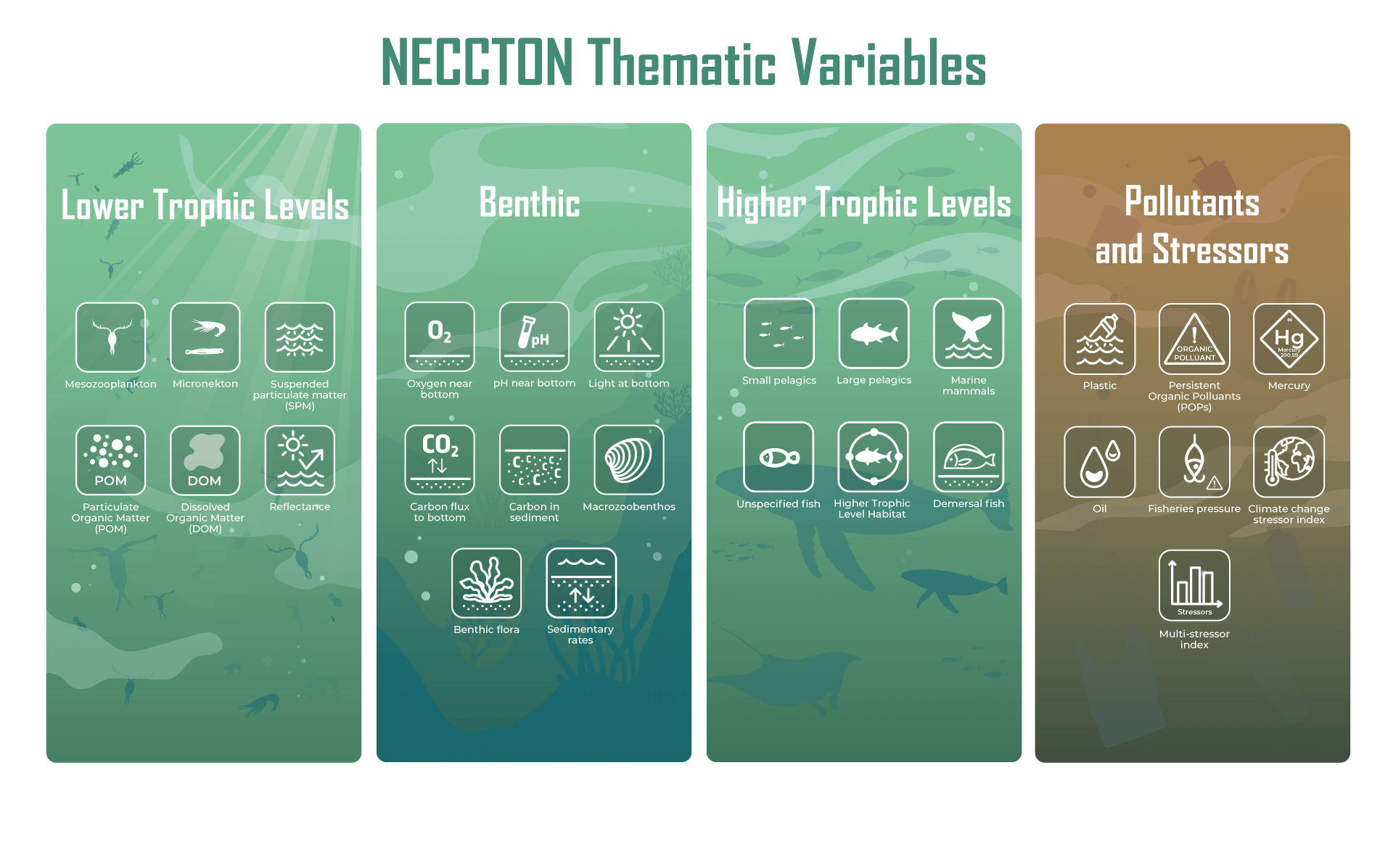
This glossary provides definitions for the key marine ecosystem variables modelled and monitored across the NECCTON project. These variables span four broad classes — from the foundational lower trophic levels that underpin marine food webs, through the benthic environment, up to the higher trophic level organisms that depend on them, and the anthropogenic pollutants and stressors that threaten them.

Each thematic variable represents a measurable indicator of ocean health and function, drawn from our marine ecosystem models, integrated with satellite observations and in situ monitoring, also by means of Artificial Intelligence. Together they form the basis of NECCTON's modelling framework, designed to deliver operational products within the Copernicus Marine Service to support the conservation of marine biodiversity, fisheries management, and climate change assessment.

Benthic
Benthic Flora

Benthic Flora

Benthic flora are essential elements in benthic-pelagic coupling and in carbon sequestration (blue carbon).  Besides uptake of inorganic carbon and production of oxygen, the most important species of flora are habitat builders that often help stabilise sediment (e.g., seagrasses) and provide shelter, spawning, and nursery ground for multiple species, including some of commercial interest. Moreover, benthic flora typically supports high associated biodiversity. 

Benthic
Carbon flux to the bottom

Carbon flux to the bottom

The flux of organic carbon to the bottom critically drives benthic ecosystems through the benthic food chain, diagenesis, and quantity of carbon sequestration through burial. The difficulty of in-situ determination greatly limits Information on carbon flow to the bottom at the ecosystem scale. Models can provide important information on carbon flux to the bottom at ecosystem scale and on its spatial and temporal variation.

Benthic
Carbon in sediment

Carbon in sediment

This product will provide maps of the vertically integrated carbon content in sediment for the North, Baltic, Black and Mediterranean Seas. Sedimentary carbon content provides information on the amount of food available to support the benthic food web and diagenetic processes. Its spatial distribution offers information on the functioning of benthic organisms (suspension versus deposit feeding).

Higher Trophic Levels
Demersal fish

Demersal fish

The demersal fish are those species that spend a fraction of their lives in close association with the seabed, feeding primarily on bottom organisms. A typical example of a demersal fish is cod (Gadus morhua). Demersal fish are often an important target of fisheries in marine shelf ecosystems. Demersal fish act as couplers of pelagic and benthic energy pathways.

Lower Trophic Levels
Dissolved Organic Matter (DOM)

Dissolved Organic Matter (DOM)

Dissolved Organic Matter (DOM) is dissolved matter originating from living matter that operationally is not retained by filtration. It can be produced in situ from phytoplankton, zooplankton and bacteria and can also be of terrestrial origin. It is further modified through bacterial utilisation. Dissolved organic carbon is often separated into different fractions based on decomposition timescales into labile, semi-labile, semi-refractory and refractory pools. Commonly the refractory pool is not included within models as its turnover time is on the order of 100-1000s of years.

Pollutants and Stressors
Fisheries Pressure 

Fisheries Pressure 

Bottom trawl fisheries have long been regarded as the major threat to benthic ecosystem functions since there is no equivalent human physical disturbance on the sea floor in terms of spatial and temporal extents (Jennings and Kaiser, 1998; Thrush and Dayton, 2002; Crowder et al., 2008). While there is ample evidence of fisheries impacts on organisms themselves (Jones, 1992; Kaiser et al., 2002; Sciberras et al., 2018), more comprehensive views on ecosystem-wide damages have been advocated so that the burden of proof becomes a stronger management incentive (Dayton, 1998; Agardy, 2000). Nowadays, European waters are among the most documented in terms of vulnerability to bottom trawling impact, but evaluations still remain to be done in some areas. We will provide such an evaluation for the northwest shelf of the Black Sea.

Higher Trophic Levels
Large pelagics

Large pelagics

The current Copernicus Marine Service does not include operational models for large pelagic fish species and other higher trophic levels of marine ecosystems (HTL). This limitation prevents Copernicus Marine Service from providing stakeholders with products to assess the diversity and biomass of commercial or endangered marine species. Implementing operational models for HTL is a challenge due to the complexity of biological systems and hence their modelling. HTL models are also more diverse than physical or biogeochemical models since they target multiple questions for management and conservation, ranging from ecosystem services to catch quotas or fishing area closures for specific species or fisheries. NECCTON propose new developments enabling Copernicus Marine Service to model and deliver HTL products by all MFCs with the objective of providing new useful decision-tools to all stakeholders involved in the management of fisheries and conservation of marine ecosystems.

Benthic
Light at Bottom

Light at Bottom

Bottom light availability is an important environmental information in determining regions where marine flora; seaweeds, seagrasses and microphytobenthos; can develop. We will deliver the bottom light product as Photosynthetic Active Radiation (PAR), which includes radiation wavelengths between 400-700 nm.

Benthic
Macrozoobenthos

Macrozoobenthos

The macrozoobenthos, usually defined as benthic macrofauna larger than 1 mm in size, is an essential element in benthic-pelagic coupling, because it mediates particulate and solute fluxes between the water column and sediments. It degrades organic matter that sinks to the bottom, changes biogeochemical properties of sediments via bioturbation and bioirrigation, affecting, for instance, rates of microbial oxidation and denitrification. It also serves as a food source for higher trophic levels, thus helping to sustain fish and fisheries. Macrozoobenthic communities, in turn, respond to organic matter supplied from the water column, hydrodynamic regime, and temperature. Major feeding groups (suspension and deposit feeders) differ in diet composition and vertical habitat distribution, which defines their functioning. In turn, their environment and changes in its characteristics affect these groups differently.

Higher Trophic Levels
Marine mammals

Marine mammals

Understanding the distribution of marine mammals (MM) is essential to gain insights into their ecology and population dynamics, to implement conservation and management measures and assess their effectiveness, and to project the future of the ecosystem services and goods they provide (food provisioning, top-down control of the food web, carbon regulation, tourism, and leisure). The current Copernicus Marine Service does not include any products for large marine top predators such as marine mammals. This limitation prevents Copernicus Marine Service from providing stakeholders with products to assess the role of large marine top predators on the ecosystem. NECCTON will provide a new HTL model for marine mammals with the objective of providing new useful decision-tools to all stakeholders involved in the management or conservation of high trophic levels.

Pollutants and Stressors
Mercury

Mercury

Mercury (Hg) is a persistent, bioaccumulative, toxic pollutant. In the ocean, inorganic Hg is converted into neurotoxic methylmercury (MeHg) that bioaccumulates and biomagnifies in marine food webs, raising a concern for wildlife and human health. MeHg production is thought to be an incidental process associated with the microbial degradation of organic matter in the water column and seabed.

Lower Trophic Levels
Mesozooplankton

Mesozooplankton

Mesozooplankton are heterotrophic organisms in the size range from 0.2 to 20 mm. Mesozooplankton move with ocean currents but can migrate vertically in the water column. Mesozooplankton generally feed on primary producers, microzooplankton and detritus particles. They are an important prey for fish larva and planktivorous fish and therefore represent an important link between primary producers and higher trophic levels.

Lower Trophic Levels
Micronekton

Micronekton

Micronekton is a group of marine organisms characterized by a size range from 2 to 20 cm. It gathers various taxa and encompasses crustaceans, fish, and cephalopods. It constitutes an intermediate compartment of the oceanic trophic web as it feeds on zooplankton and it is the main prey of larger marine predators. Micronekton is considered to be a key player in the biological pump. It performs diurnal vertical migration (DVM) based on predation pressure. These organisms migrate every day between the surface where they feed during the night, and the deep ocean where they hide from predators during the day.

Pollutants and Stressors
Multi-stressor Index

Multi-stressor Index

Marine ecosystems are currently facing the pressure of multiple climate-related stressors and their impact is projected to increase in the future due to climate change. Climate-related stressors arise directly from climate change in the marine environment, hence from warming, acidification and deoxygenation. Methods for the estimation of stressors in marine species are well developed but their full impact is seldom adequately harnessed as impact studies are generally confined to scientific and grey literature and/or single stressors are considered in isolation.

Pollutants and Stressors
Oil

Oil

Oil spills can seriously affect the marine biota both as a result of toxic effects and physical smothering. The severity of impact depends on the spill quantity, exposure time and type of oil, the environmental conditions and the sensitivity of the affected organisms and their habitats to the oil. The toxic components of oil are low molecular weight aromatic compounds: monoaromatic and polynuclear aromatic hydrocarbons (MAHs and PAHs), which are both volatile and soluble in water.

Benthic
Oxygen near Bottom

Oxygen near Bottom

Bottom Oxygen concentration is an indicator of ecosystem health and particularly the presence of coastal hypoxia that often occurs at the bottom.

Lower Trophic Levels
Particulate Organic Matter (POM)

Particulate Organic Matter (POM)

Particulate Organic Matter (POM) in the ocean is operationally defined as all combustible organic matter that can be retained on a filter (Kharbush et al. 2020). The filter mesh size is typically 0.7. It is often discussed in terms of Particulate Organic Carbon (POC), which reflects the important role POC plays in the ocean carbon cycle. The definition explicitly excludes Particulate Inorganic Carbon (PIC). The finite mesh size means the contribution of organisms smaller than 0.7 including most photosynthetic and non-photosynthetic prokaryotes is not captured in measurements. At the other end of the size spectrum, the contribution of large, motile zooplankton is also not measured. Such organisms are either intentionally removed through filtering, or through sampling techniques which are designed to exclude larger, swimming organisms. The operational definition of POM and POC contrasts with the definition used in most marine ecosystem and biogeochemical models. In marine ecosystem models, POM tends to be exclusively made up of non-living detrital material, including faecal pellets, the bodies of dead organisms, or other aggregations of organic matter.

Pollutants and Stressors
Persistent Organic Pollutants (POPs)

Persistent Organic Pollutants (POPs)

(PFAS) Persistent Organic Pollutants (POPs) are chemical compounds which (1) have a long effective environmental lifetime, (2) are bioaccumulative, (3) and have adverse effects on humans and ecosystems (e.g. toxic, carcinogenic, endocrine). Within the marine ecosystems, these compounds can persist for extended periods and accumulate in organisms, posing significant threats to both wildlife and human health. POPs include a wide range of synthetic chemicals, such as pesticides, pharmaceuticals, plasticizers, coatings, and even some unintentional byproducts of industrial processes.

Benthic
pH near Bottom

pH near Bottom

Potential Hydrogen, better known as pH, is a measure of acidity/ basicity of a solution expressed on a logarithmic scale; a pH of 7 denotes a neutral solution whereas lower and higher values characterise more acidic and alkaline waters, respectively, compared to the neutral state. Studies generally report pH on a concentration scale representing a measure of proton activity. As a measure of acidification, pH represents an important indicator of ecosystem health.

Pollutants and Stressors
Plastic

Plastic

A significant amount of plastics currently ends up in the marine environment, raising concern for wildlife and human health. Plastics affect marine organisms through ingestion and/or entanglement, while microplastics that represent the smaller size class (particles <5 mm), may interact with low trophic-level organisms (i.e., phytoplankton and zooplankton) and their predators, finding their way up the food chain and human diet. Microplastics are either primary (personal care products, pre-production pellets) or secondary, originating from the fragmentation of larger items. Plastics in the marine environment originate from both land-based sources (coastlines ~39-42%, rivers 12-13%) and sea-based sources (fishing activities 45-48%), with their fate being determined by various physical (waves, currents, wind) and biogeochemical (e.g., biofouling) processes. Thus, models taking into account the most important processes and source inputs provide powerful tools for the assessment of marine litter pollution.

Lower Trophic Levels
Reflectance

Reflectance

Reflectance (RRS) is the ratio of the electromagnetic flux reflected by a surface to the total electromagnetic flux incident on the surface. Water reflectance, as a function of the wavelength of electromagnetic radiation, provides useful information about the different types of suspended and dissolved components of matter in the ocean. It is used to identify various spectral features through the analysis of their inherent optical properties (i.e., absorption and backscattering). RRS is used to derive chlorophyll using empirical algorithms.

Benthic
Sedimentary rates

Sedimentary rates

This product will provide maps of carbon sequestration (I.e. carbon burial) and denitrification rates (NO3 removal) in Black Sea sediment.

Higher Trophic Levels
Small pelagics

Small pelagics

Small pelagic fishes (SPF) are a key component of marine food webs, often present with a large but fluctuating biomass of mid-trophic level fish, therefore making the link between primary and secondary productions and top predators. They also constitute a group of major economic importance for several countries. Implementing operational models for such organisms is a challenge due to the complexity of biological systems, which results in a large diversity of models allowing to address multiple questions for management and conservation, ranging from ecosystem services to catch quotas or fishing area closures for specific species or fisheries.

Lower Trophic Levels
Suspended Particulate Matter (SPM)

Suspended Particulate Matter (SPM)

Suspended particulate matter (SPM) is a collective term for the inorganic (e.g., mineral) and organic (e.g., detritus; see next section) particulates that are suspended in the water column. It is an indicator of sediment transport, water clarity and quality; and has important implications for pelagic and benthic productivity and erosion. It can also act as a vector for the transfers of pollutants and contaminants.

Higher Trophic Levels
Unspecified fish

Unspecified fish

Unspecified fish biomass are those fish species that do not fall into the categories of small pelagic species, large pelagic species or demersal fish species (both small and large). In NECCTON this would be the total biomass of all fish, i.e. include all these biological subcomponents.

Want to learn more about the project?

NEWS AND PROJECT UPDATES

March 3, 2026|Project Update

NECCTON Highlights Ecosystem Forecasting Developments at European Ocean Days

NECCTON Presented at European Ocean Days: Supporting Ecosystem Forecasting for EU Marine Policy During the Marine Knowledge for Ocean Health session at European Ocean Days, the coordinator of the NECCTON project outlined how Europe is developing the capacity to produce operational marine ecosystem forecasts and why this capability is increasingly relevant for policy and management....

Learn more
February 27, 2026|Project Update

NECCTON Co-Organises Marine Ecosystem Modelling Session at OSM26

At the Ocean Sciences Meeting 2026 in Glasgow (22–27 February 2026), NECCTON co-organised the session “Advancing Marine Ecosystem Modeling for a Predictable and Sustainable Ocean” together with OceanPredict’s Marine Ecosystem Analysis and Prediction Task Team. ...

Learn more
October 20, 2025|News

Mapping 25 Years of Micronekton Dynamics Across Changing Ocean Provinces

This study defines environmentally similar “provinces” to map and track changes in micronekton biomass and vertical structure from 1998 to 2023, shedding light on the seasonal and year‑to‑year variability of these key mid‑sized ocean organisms that drive deep‑sea carbon export and feed many marine predators....

Learn more