About the project

NECCTON will enable the Copernicus Marine Service to better inform ocean policymakers, managers and publics about biodiversity conservation and fisheries management, by means of new modelling products for the green ocean: fishes, pollution and benthic habitats.
 
NECCTON will enable CMEMS to provide twenty-five new or improved products as shown below:
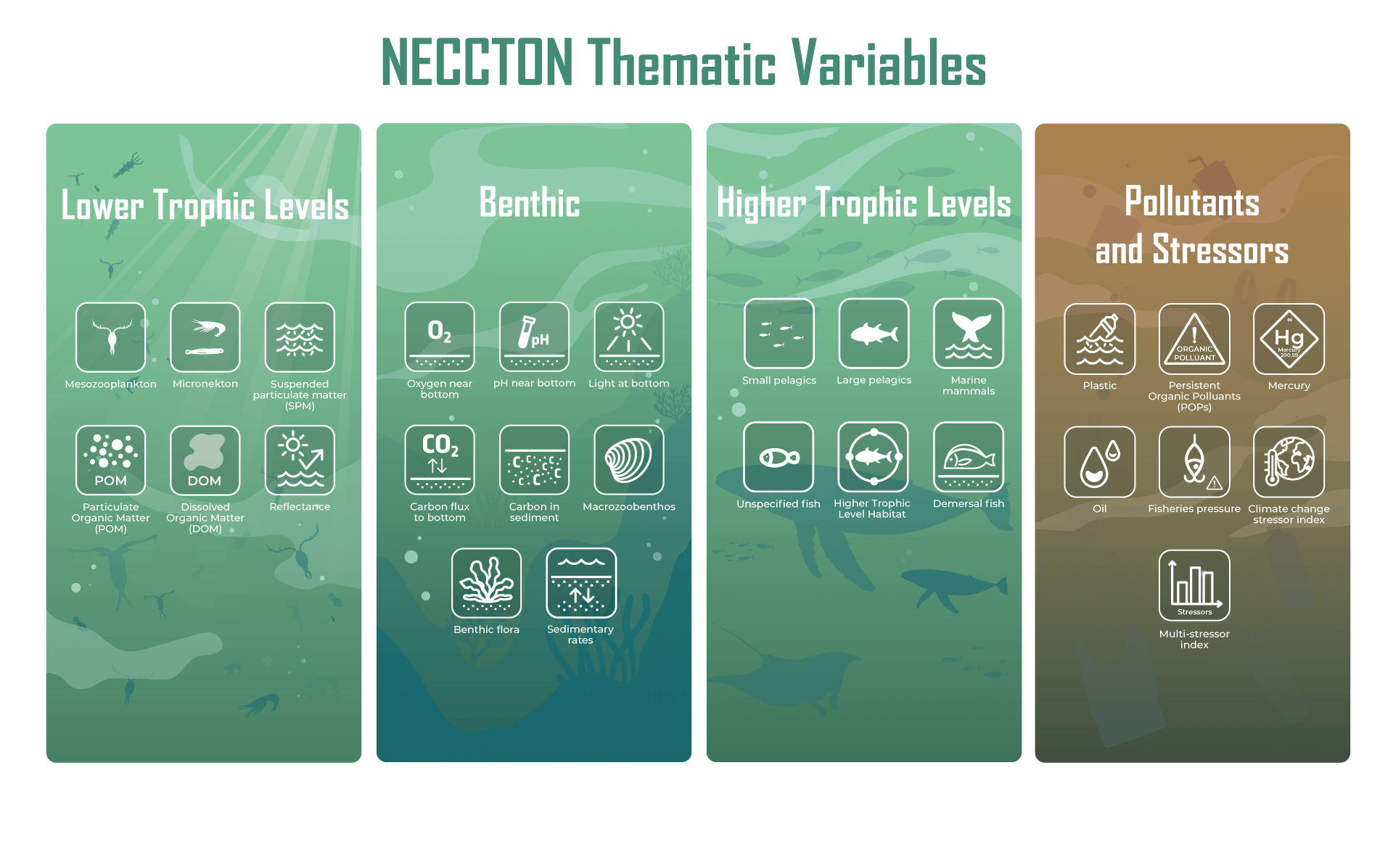
 
NECCTON.jpg

Central Hypothesis

The NECCTON vision is of a fully integrated modelling system that closely represents the functioning of the real marine ecosystem. To achieve this, we will build and integrate new and innovative models that can simulate marine high trophic levels, the benthic environment, the fate of pollutants and the impact of climate scenarios on ocean ecosystems.

The products from this system can be used for many applications including fostering ocean biodiversity conservation, supporting food security, and informing European policies.

We will achieve this through implementation of our central hypothesis:

" credible products and scenarios of food resources and biodiversity need systems that fuse observations into integrated models of the physics, biochemistry, fauna and flora components of ocean ecosystems, across benthic and pelagic habitats, and across multiple pressures including climate, fisheries and pollution". 

NECCTON illustration

NECCTON will feed into the Copernicus Marine Service which will enable a much wider range of uses and applications. The diagram below shows the Copernicus Marine Service before and after the addition of the NECCTON products. Before NECCTON the Copernicus Marine Service could only forecast and examine ocean physics and aspects of biogeochemistry.

Addition of the NECCTON products will mean that the Copernicus Marine Service is able to offer:

  • Improved biogeochemical products
  • Modelling of higher trophic levels
  • Modelling of the benthic habitat
  • Modelling of marine pollution

This will lead to new capabilities including:

  • MPA management
  • Biodiversity conservation
  • SDG reporting
  • Fish stock management
  • Support for aquaculture operations

Fundamental Concepts

NECCTON will push the current boundaries of operational ocean modelling, by means of the three pronged unifying approach:

The conceptual coupling of marine ecosystem processes to take account of two way feedbacks between biotic and a biotic components, habitats, trophic levels and stressors.

The integration of ecosystem models, satellite and in situ observations using novel artificial intelligence, machine learning and assimilation approaches.

Development of the framework inter-linking the libraries of all the current Copernicus Marine Service biogeochemical and physical models with the ecosystem model components developed and applied in NECCTON. This will facilitate knowledge sharing between Copernicus core developers and its users.
NECCTON-Illustration.png

Objectives

The overall objective of NECCTON is to enable CMEMS to deliver products that inform marine biodiversity conservation and food resources management, by fusing innovative ocean ecosystem models and new data.

Biomass, production, migration and spatial distribution of marine higher trophic level organisms are intrinsically linked to environmental conditions and bottom-up trophic processes. NECCTON will link state-of-the-art higher trophic level models to current Copernicus Marine Service coupled physical-biogeochemical models. This will deliver operational products for nekton communities that support policy development and economic growth.

Biophysical interactions strongly influence habitat suitability for higher trophic level organisms. NECCTON will improve and extend the current Copernicus Marine Service capacity to deliver physical and biogeochemical products for the lower trophic levels of the marine ecosystem, which will improve support for higher trophic level modelling.

The benthic habitat is a vital and integral component of the marine ecosystem. NECCTON will build Copernicus Marine Service capacity on modelling benthic flora, fauna and sediments, to deliver products characterizing the variability of the biological communities.

NECCTON will build Copernicus Marine Service capability to model marine pollution and to assess integrated pressures, to deliver operational products that are relevant to protect biological communities.

Simulations of an ecosystem’s response to climate change scenarios are a valuable tool for marine management. NECCTON will develop capability for the Copernicus Marine Service to perform both hindcast and climate projections for biodiversity conservation and food resource management.

NECCTON will provide Copernicus Marine Service with new capability in integrating numerical model simulations and new and consolidated types of observations by making use of machine learning techniques and advanced data assimilation approaches.

NECCTON will develop a prototype modelling framework inter-linking the newly developed ecosystem-model components with all the existing Copernicus Marine Service biogeochemical and physical models. This will facilitate the sharing of models throughout the Copernicus Marine Service and enable model ensemble exercises to assess the reliability of products.

Partners

This project wouldn't be possible without the hard work and dedication of our team of partners.

View partners
Whales swimming in the ocean

Want to learn more about the project?

NEWS AND PROJECT UPDATES

March 12, 2026|News

NECCTON Launches Advanced Ocean Viewer, Bringing Europe’s Next-Generation Marine Ecosystem Data to the World

The NECCTON project has reached a major milestone with the public release of the NECCTON Ocean Viewer, an open, interactive web platform designed to transform how users explore, understand, and apply cutting edge marine ecosystem information. Now live at https://data.neccton.eu , the viewer delivers unprecedented access to a rapidly expanding catalogue of harmonised, cloud optimised datasets that ...

Learn more
March 3, 2026|Project Update

NECCTON Highlights Ecosystem Forecasting Developments at European Ocean Days

NECCTON Presented at European Ocean Days: Supporting Ecosystem Forecasting for EU Marine Policy During the Marine Knowledge for Ocean Health session at European Ocean Days, the coordinator of the NECCTON project outlined how Europe is developing the capacity to produce operational marine ecosystem forecasts and why this capability is increasingly relevant for policy and management....

Learn more
February 27, 2026|Project Update

NECCTON Co-Organises Marine Ecosystem Modelling Session at OSM26

At the Ocean Sciences Meeting 2026 in Glasgow (22–27 February 2026), NECCTON co-organised the session “Advancing Marine Ecosystem Modeling for a Predictable and Sustainable Ocean” together with OceanPredict’s Marine Ecosystem Analysis and Prediction Task Team. ...

Learn more