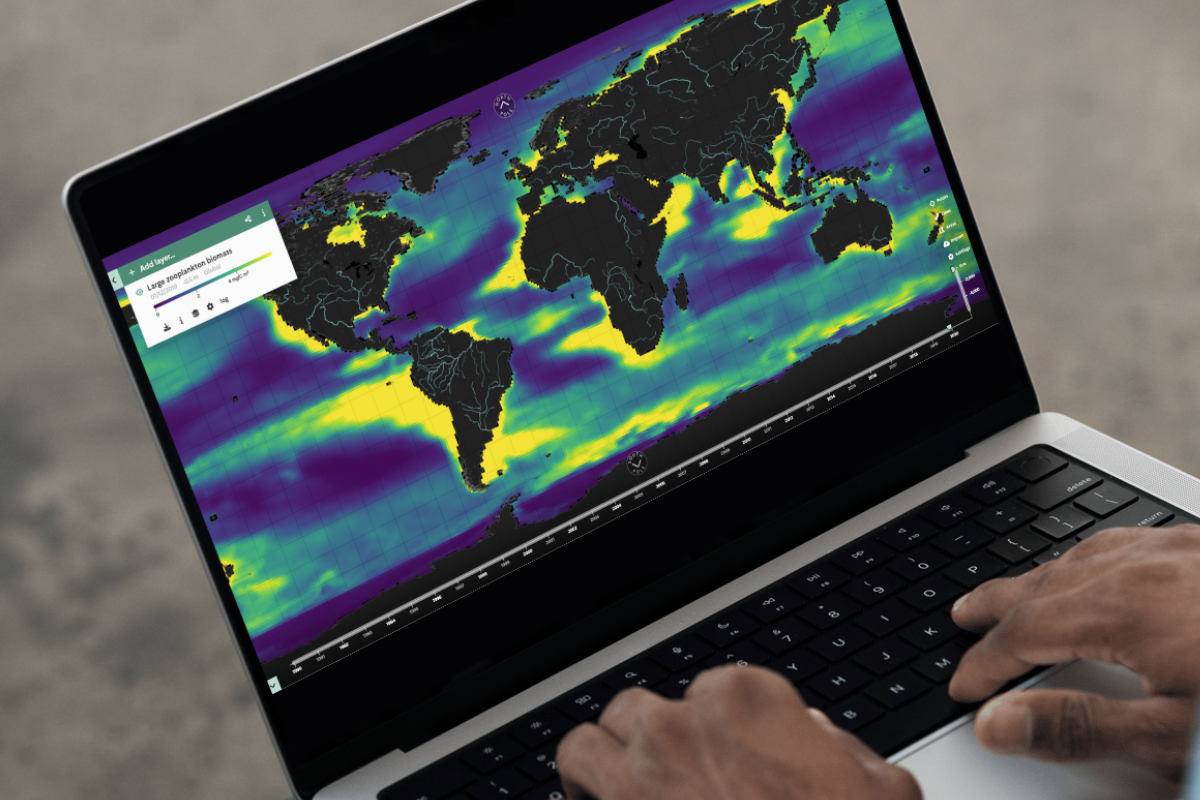
The NECCTON project has reached a major milestone with the public release of the NECCTON Ocean Viewer, an open, interactive web platform designed to transform how users explore, understand, and apply cutting edge marine ecosystem information. Now live at https://data.neccton.eu, the viewer delivers unprecedented access to a rapidly expanding catalogue of harmonised, cloud optimised datasets that are essential for marine science, conservation, and policy.
Developed by Lobelia for NECCTON, the viewer is built on the Copernicus Viewer Framework, the same robust architecture behind the widely used MyOcean Pro Viewer. This ensures interoperability with existing Copernicus Marine Service tools and paves the way for seamless integration of NECCTON data into the future Copernicus Marine portfolio.
A new window into the ocean’s biodiversity and trophic networks
The NECCTON Ocean Viewer allows users to explore complex marine ecosystem data through an intuitive interface. More than 20 new products delivered by NECCTON, have already been ingested—each processed into Analysis Ready, Cloud Optimised (ARCO) datacubes in OGC Zarr format. These datacubes support efficient visualisation across space (longitude, latitude, depth) and time, enabling smooth mapping, graphing, and analysis without the need for local data processing expertise.
Users—from researchers and policymakers to environmental managers, students, and industry—can easily:
• Visualise model outputs and satellite observations through dynamic maps, animations, and depth profiles.
• Explore time series, transects, histograms, and geographic subsets by placing points, lines or areas directly on the map.
• Download customised data subsets or access the original data files.
• Export images, animations, and share interactive links, improving collaboration and communication.
All datasets have been assigned DOIs for citation and traceability, ensuring scientific and operational reliability.
A tool designed with (and for) data providers and users
An important advantage of the new viewer is that datasets are automatically published as soon as they become available. This real time visibility has allowed data providers across Europe to inspect their data rapidly, provide feedback, and resolve issues collaboratively—accelerating NECCTON’s data pipeline and improving consistency across the catalogue.
What’s coming next?
Enhancements are already planned, including:
• New datasets for ocean climate projections for the global ocean and regional seas, from biogeochemistry to fishes and marine mammals
• Improved metadata and harmonised naming for clearer dataset navigation.
• Advanced catalogue filters and unified thumbnails for a more user friendly browsing experience.
• Visualisation of model uncertainty, both spatially and in time series.
• Support for in situ observations, enabling side by side comparison with models.
• Immersive case study visualisations to better engage stakeholders on climate impacts and marine ecosystem change.
• Sharing data with the European Digital Twin Ocean