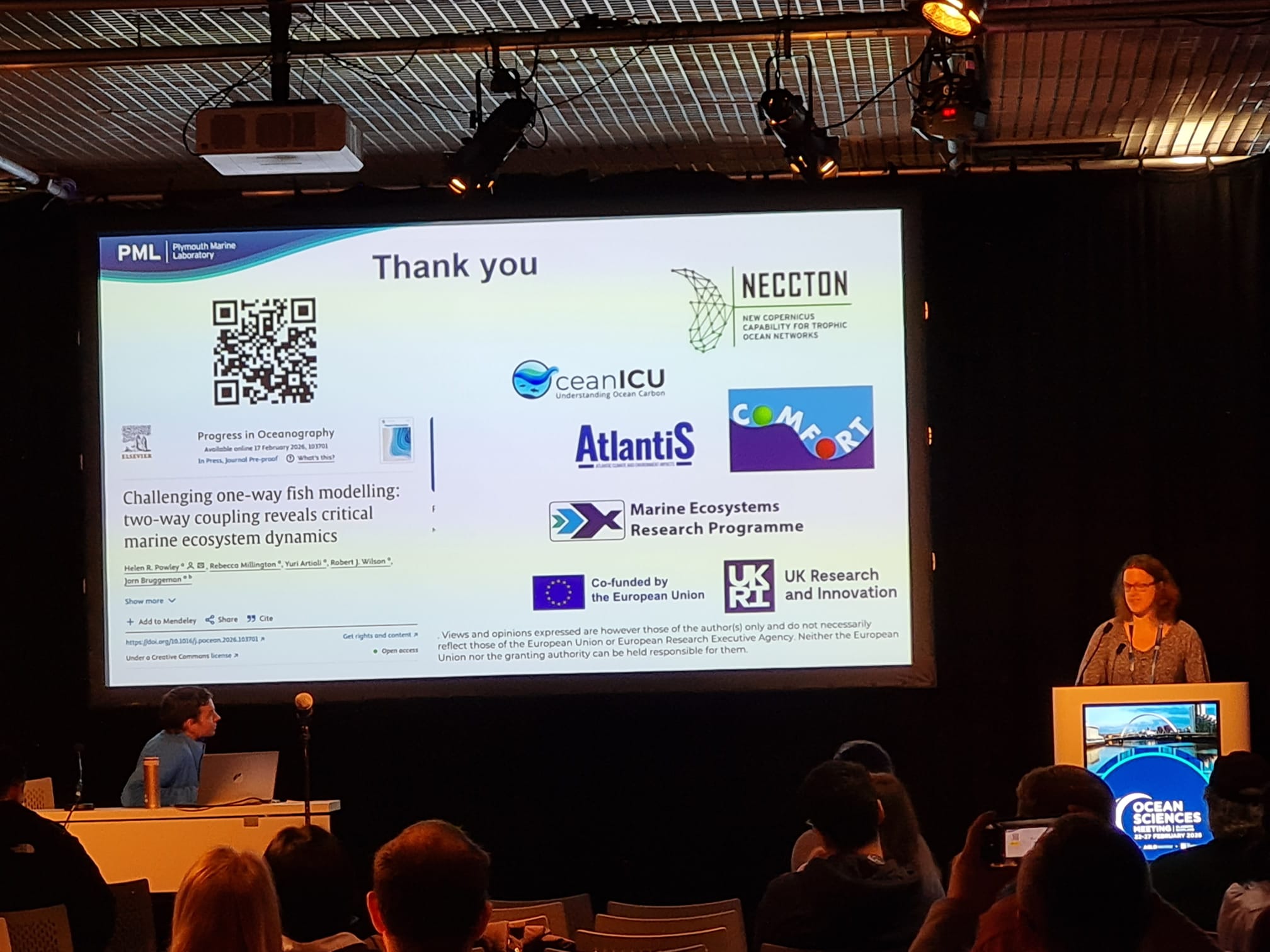
At the Ocean Sciences Meeting 2026 in Glasgow (22–27 February 2026), NECCTON co-organised the session “Advancing Marine Ecosystem Modeling for a Predictable and Sustainable Ocean” together with OceanPredict’s Marine Ecosystem Analysis and Prediction Task Team.
The session showcased how integrated ecosystem models — combining Copernicus Marine Service outputs, in situ observations, and artificial intelligence — are strengthening science-based decision-making for climate resilience, biodiversity protection, and sustainable ocean management. Contributions addressed operational forecasting, multi-stressor assessment (including pollution, deoxygenation and marine heatwaves), biodiversity monitoring, and climate adaptation of fish populations.
During the poster session, NECCTON researchers highlighted advances in modelling zooplankton migration and carbon export (Veli Çağlar Yumruktepe, NERSC), sediment resuspension and oxygen dynamics in the Black Sea (Mathurin Choblet, University of Liège), light penetration and productivity in the Mediterranean (Giovanni Galli, OGS), micronekton dynamics for fisheries and carbon cycling (Sarah Albernhe, Mercator Ocean International), and machine learning approaches to predicting plankton diversity (Sakina-Dorothée Ayata and Laetitia Drago, Sorbonne Université).
Together, the session demonstrated how next-generation ecosystem modelling is becoming a strategic tool for delivering a more predictable and sustainable ocean.